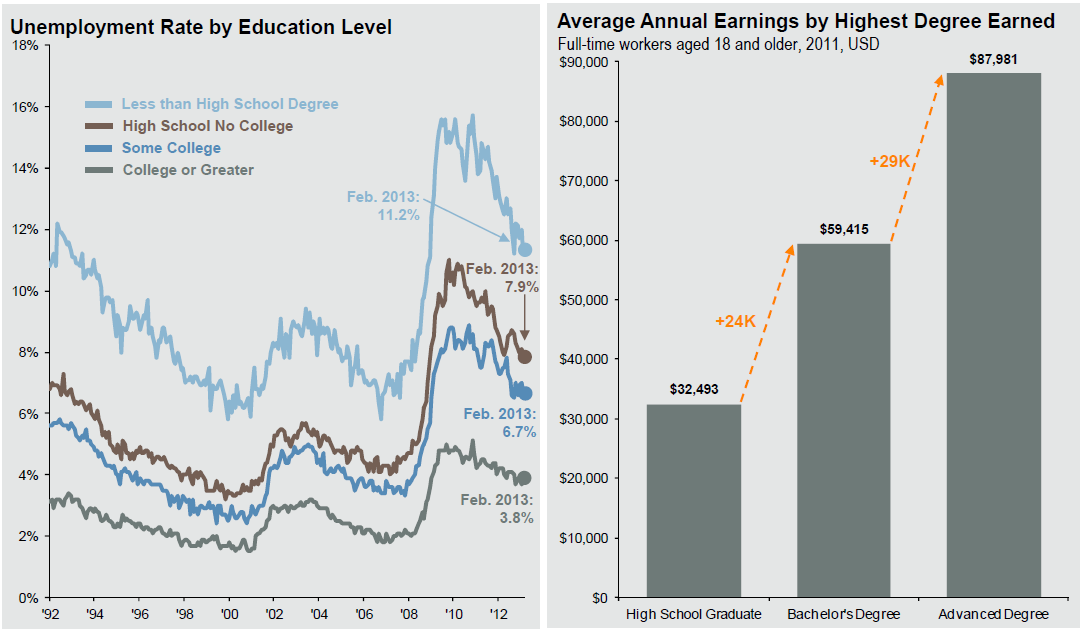
These graphs (via Manan Shukla) confirm what we already know. That is, we are more likely to be employed, and earn higher incomes, if we are better educated. That has been true for a long time. Consequently, it does not help to explain why unemployment was high during the recovery from the 2000 recession, and during our current recovery from the financial crisis. Some argue that education level has become even more important because there is less demand for unskilled labor and more demand for skilled labor. According to this hypothesis, we can remedy the unemployment problem by reforming our education system. Its hard to argue against improving the education system, or for increasing access to higher education. That would certainly, over the long haul, be good for social mobility and equality of opportunity. However, it may not remedy the problem of high unemployment, and it does not address the decline in median household income, and rising income inequality, that have been endemic in the global economy. The relationship between education, falling wages, and rising income inequality is not obvious. They are probably better explained by changes in the political economy that have been underway for the last 40 years.
Tuesday, April 2, 2013


Living In A Black Hole, Or Life At The Zero Lower Bound
Keynes developed his general theory during the Great Depression. In a sense, the economy was in a black hole from which it was unable to escape with classical economic theory. He called this black hole the liquidity trap. We are in a similar situation today. After taking on too much debt, many households and firms are paying off their debt instead of spending and investing. Paying down debt is a form of savings. Ordinarily, when the supply of savings increases, the interest rate falls. That should stimulate investment and consumption to absorb the savings. Unfortunately, interest rates are close to zero, but the level of interest rates would have to be negative to reduce the excess supply of savings. Since nobody wants to make loans at negative interest rates we hold on to cash. We are at the zero lower bound in which interest rates can't fall far enough to absorb the excess savings.
One way to absorb the excess savings is to have a depression. GDP or national income falls and savings fall with the decline in income. Keynes did not believe that depression was the best way to deal with an economy that was at the zero lower bound. He argued that government should borrow the excess savings and increase spending. That would provide income to households and businesses that would increase private spending. The goal is to produce a full-employment economy.
This topic has become current because government debt has risen and because the Fed and other central banks have reduced short term interest rates to the zero lower bound (real interest rates are negative when corrected for inflation). Efforts are underway in many countries to reduce government spending, and some are calling on the Fed and other central banks to raise interest rates. According to Keynesian theory, the result of those policies would be continuing depression and high unemployment.
One way to absorb the excess savings is to have a depression. GDP or national income falls and savings fall with the decline in income. Keynes did not believe that depression was the best way to deal with an economy that was at the zero lower bound. He argued that government should borrow the excess savings and increase spending. That would provide income to households and businesses that would increase private spending. The goal is to produce a full-employment economy.
This topic has become current because government debt has risen and because the Fed and other central banks have reduced short term interest rates to the zero lower bound (real interest rates are negative when corrected for inflation). Efforts are underway in many countries to reduce government spending, and some are calling on the Fed and other central banks to raise interest rates. According to Keynesian theory, the result of those policies would be continuing depression and high unemployment.
Monday, April 1, 2013
The Problem Of Capital Accumulation In Capitalism
This article (via Manan Shukla) has a link to an animated video by David Harvey. There have been a number of explanations given for our current economic problems. David Harvey quickly goes through the entire litany of explanations. He believes that there is some truth in each of the explanations. However, he argues that there is an underlying problem in capitalism that is behind most of our financial crises. Capitalism is faced with a need for constant expansion. It relies upon financial innovations to inflate economies when they get into the doldrums. The financial innovations often do what they were intended to do. They inflate the economy, but the innovations often lead to debt crises like those that we have today. We move the crisis from one geography to another.
David Harvey's analysis is drawn from Marx's critique of capitalism. Marx devoted much of his life to the study of capitalism and its contradictions. He was quite good at it. Harvey has a good grasp of Marx's critique of capitalism. He does not, however, have a solution to the problems that are built into capitalism. Somehow it finds ways of getting around its contradictions, and it is ofter painful for many. Moreover, he does not believe that Marx was able to come up with a superior alternative to capitalism. He believed that central planning, and state ownership of the means of production would be a better alternative, but complex economies are not easy to plan, and states have not been better at allocating resources to their most productive uses.
David Harvey's analysis is drawn from Marx's critique of capitalism. Marx devoted much of his life to the study of capitalism and its contradictions. He was quite good at it. Harvey has a good grasp of Marx's critique of capitalism. He does not, however, have a solution to the problems that are built into capitalism. Somehow it finds ways of getting around its contradictions, and it is ofter painful for many. Moreover, he does not believe that Marx was able to come up with a superior alternative to capitalism. He believed that central planning, and state ownership of the means of production would be a better alternative, but complex economies are not easy to plan, and states have not been better at allocating resources to their most productive uses.
Did The US Invade Iraq To Keep Oil Prices High?
This article (via Manan Shukla) argues that the US did not invade Iraq in order to privatize its oil fields. The US oil companies did not want more oil, they wanted high oil prices. Iraq had been exceeding its OPEC quota. The extra oil supply was keeping oil prices down. The solution was to create a state oil company that would cooperate with OPEC by not exceeding its quotas. This has kept oil prices high which pleases the oil companies, and the Saudi's who dominate the OPEC cartel.
DSGE Despair
Macroeconomics is essentially about the use of DSGE models to predict the effect of policy changes on the economy. The models are not very good at prediction, but that seems to have little impact on their use. They are used by many central banks, and every aspiring graduate student has to become familiar with DSGE models. They are a badge of the profession.
This article provides a good explanation of the problems with DSGE models and it explains why they are not very good at prediction. The author was a physics major who just received his PhD from Michigan in macroeconomics. His views on DSGE models probably encouraged him to take a job teaching financial economics rather than pursuing a career in macroeconomics.
This article provides a good explanation of the problems with DSGE models and it explains why they are not very good at prediction. The author was a physics major who just received his PhD from Michigan in macroeconomics. His views on DSGE models probably encouraged him to take a job teaching financial economics rather than pursuing a career in macroeconomics.
Is California The Model For The Rest Of The Country
Paul Krugman argues the conservative movement in the US took root in California. Even when Republicans were in the minority, they had enough votes to block whatever Democrats proposed. Today, that is no longer true. The GOP has been marginalized. It does not have enough votes to obstruct the Democratic government.
California still has a lot problems but it has had a well deserved reputation for being a bellwether state. Things that start in California spread elsewhere to other parts of the country. Perhaps the GOP will become marginalized enough so that it cannot block progressive proposals in Washington. I wish that were true but the GOP is increasing its power in many states, and lobbyists determine what happens in government more than we would like.
California still has a lot problems but it has had a well deserved reputation for being a bellwether state. Things that start in California spread elsewhere to other parts of the country. Perhaps the GOP will become marginalized enough so that it cannot block progressive proposals in Washington. I wish that were true but the GOP is increasing its power in many states, and lobbyists determine what happens in government more than we would like.
Jeff Sachs Presents A Menu For An Economy With Chronic Problems
Jeff Sachs argues that the global economy presents problems are not easily dealt with by short term stimulus programs. He proposes a number of longer term projects that are required to deal with the structural problems that he sees in the economy. Government will have to take a more active role to address the problems that he describes. That means more government spending rather than less government spending. Cutting taxes, which is the panacea advocated for every problem by Republicans, only limits the ability of government to take a more active role in the economy. That is one of the reasons why he has been critical of the administration for making most of the Bush tax cuts permanent.
Subscribe to:
Posts (Atom)